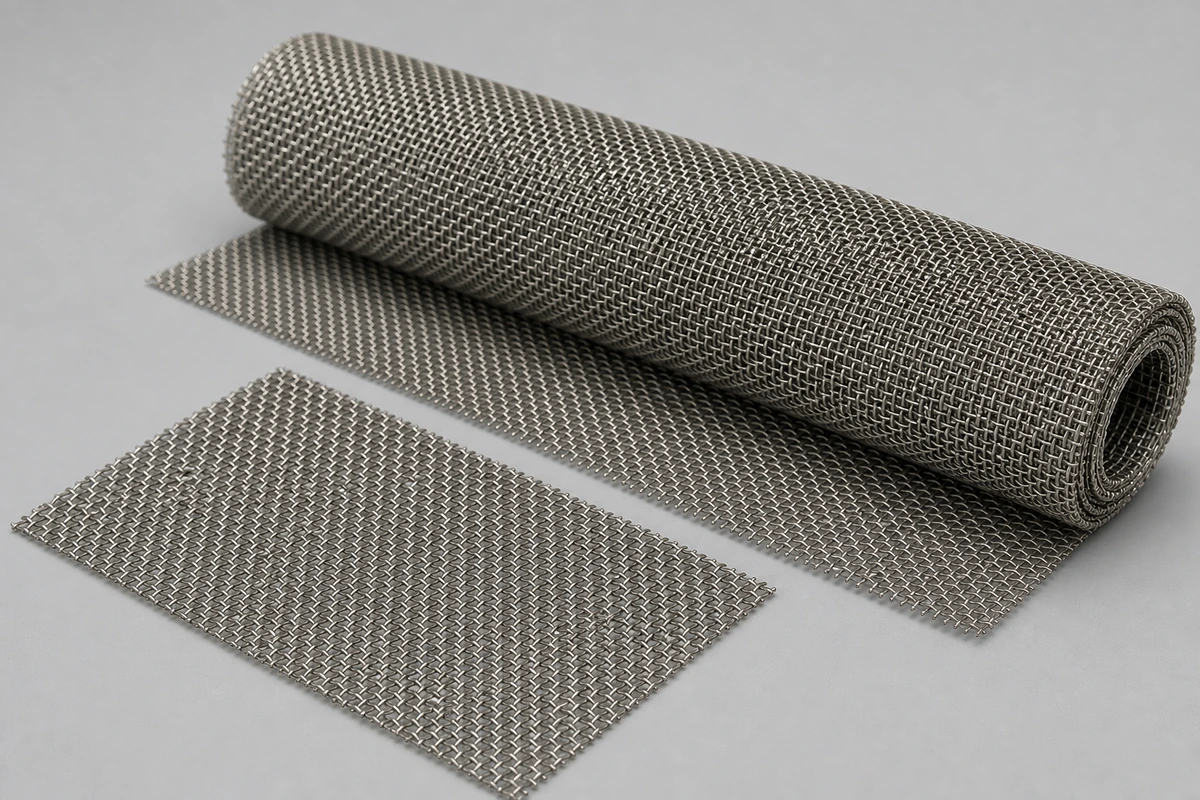
For twill weave wire mesh in 316L Stainless Steel, the controlling selection factors are the media being filtered, the cleaning regime and the service temperature. The grade data for 316L Stainless Steel is summarized below together with every specification supplied.
Why Choose 316L Stainless Steel for Twill Weave Wire Mesh
The default filtration and process-industry grade. For twill weave wire mesh, this matters when superior resistance, including chlorides, brines, food CIP and mild acids is the controlling requirement.
Alloy Properties
| Grade designation | AISI 316L (1.4404) |
|---|---|
| Magnetic response | Essentially non-magnetic |
| Service temperature | approx. +550 °C continuous |
| Corrosion characteristic | Superior resistance, including chlorides, brines, food CIP and mild acids |
Corrosion Behavior in Filtration Service
316/316L adds 2–3% molybdenum to the 304 composition, which sharply improves resistance to chloride pitting and mild acids. For twill weave wire mesh in marine, brine, food-CIP and chemical-process service, 316L is the default filtration grade; the L (low-carbon) variant also resists sensitization where elements are welded into frames.
Comparable Alloys
Below 316L sits 304 (general purpose, lower cost). Above it: duplex 2205 (strength + chloride resistance), 904L and Hastelloy C-276 (hot chlorides, sulfuric), Monel 400 (HF, seawater), titanium (chlorides at minimum weight) for twill weave wire mesh.
Specifications of Twill Weave Wire Mesh Available in 316L Stainless Steel
| Mesh count | Wire diameter (mm) | Aperture (mm) | Micron rating (u00b5m) | Open area (%) | Weight SS (kg/mu00b2) | Reference standard |
|---|---|---|---|---|---|---|
| 80-Mesh | 0.160 | 0.158 | 158 | 24.6 | 1.05 | ISO 9044 |
| 100-Mesh | 0.120 | 0.134 | 134 | 27.8 | 0.74 | ISO 9044 |
| 150-Mesh | 0.080 | 0.089 | 89 | 27.8 | 0.49 | ISO 9044 |
| 200-Mesh | 0.060 | 0.067 | 67 | 27.8 | 0.37 | ISO 9044 |
| 250-Mesh | 0.050 | 0.052 | 52 | 25.8 | 0.32 | ISO 9044 |
| 325-Mesh | 0.040 | 0.038 | 38 | 23.8 | 0.27 | ISO 9044 |
| 400-Mesh | 0.036 | 0.028 | 28 | 18.8 | 0.27 | ISO 9044 |
| 500-Mesh | 0.030 | 0.021 | 21 | 16.8 | 0.23 | ISO 9044 |
| 635-Mesh | 0.024 | 0.016 | 16 | 16.0 | 0.19 | ISO 9044 |
Where 316L Stainless Steel Twill Weave Wire Mesh Is Used
- Fine sieving & powders: pharmaceutical, chemical and metal-powder screening from 200 to 500 mesh.
- Hydraulic & fuel filters: strong fine filter layers that resist pulse loads.
- Screen printing & electronics: stable fine mesh for printing and electroforming screens.
- Aerospace: fine stainless filter discs where a robust cloth is mandatory.
Ordering Twill Weave Wire Mesh in 316L Stainless Steel
- Mesh count: Twill weave is standard from about 200 mesh upward; below that it is chosen for strength.
- Wire diameter: Twill allows a thicker wire at the same count — confirm the aperture in the table.
- Flatness: Calendered twill cloth gives a thinner, flatter filter layer for discs and packs.
Mistakes to Avoid with Twill Weave Wire Mesh
- Choosing plain weave at 325+ mesh, which is weak and distorts.
- Assuming twill weave is finer than plain at the same count — only the wire changes, not the count.