Skip to content

Perforated Metal · DIN 24041 (Hv) · Application guide

What Is Hexagonal Hole Perforated Sheet Used For?

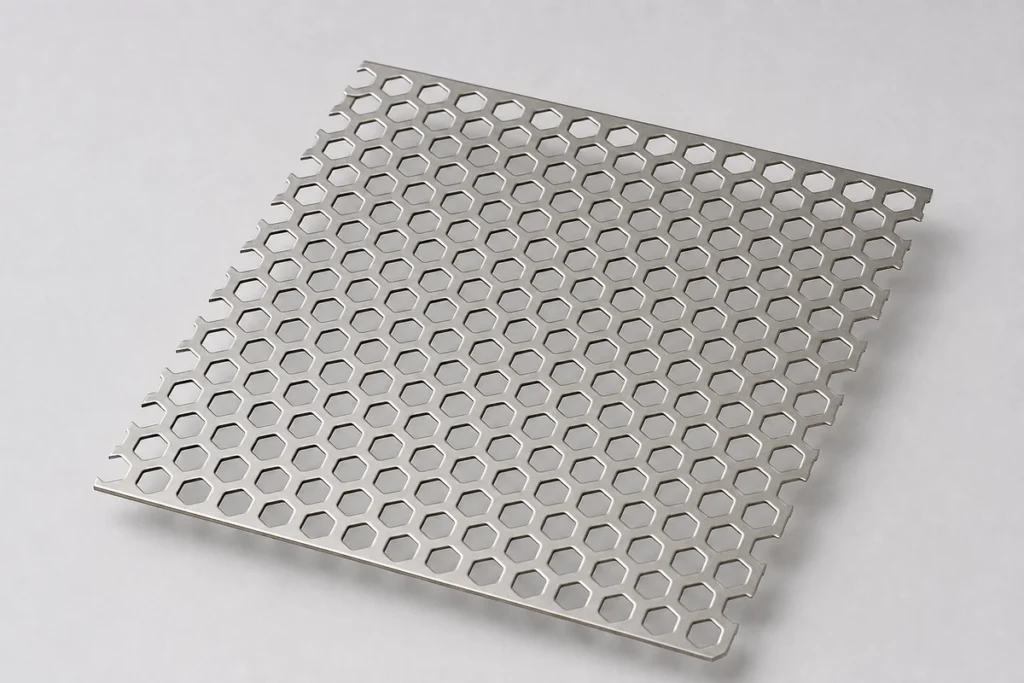
Application guide for Hexagonal Hole Perforated Sheet to DIN 24041 (Hv). The core duty of the type is high open-area decorative facades and screening. The typical industries, the how-to-specify checklist, handling practice and the exclusion cases are set out below.

Typical Applications for Hexagonal Hole Perforated Sheet

The most common settings where this is specified:

  • Machine guarding: ventilated covers and safety panels.
  • Industrial filtration & separation: removing particulates from liquids, gases and slurries in process plant.
  • OEM & fabrication: cut, formed and welded into filter assemblies, screens, guards and enclosures.
  • Maintenance & replacement (MRO): matching an existing mesh, screen or element spec when servicing installed equipment.
  • Architecture & facades: cladding, sunscreens, balustrades and ceilings.

How to Specify Hexagonal Hole Perforated Sheet for Your Application

  • Mesh count / micron rating: Match the aperture or micron rating to the smallest particle you must retain or pass. The table below lists mesh count, aperture and micron for each option — for woven cloth, specify the aperture or micron, not just the mesh count.
  • Hole pattern & open area: Pick round, slotted or hexagonal holes and the pitch that gives the open area your flow or sightline needs.
  • Material / alloy: Select the alloy for the environment — 304 for general use, 316L for chlorides, food and chemicals, brass or copper for shielding, and Monel, Inconel or Hastelloy for marine, acid and high-temperature service.
  • Environment: For damp, coastal, chemical or high-temperature service move up to 316L or a nickel alloy; for dry indoor duty 304 or a coated steel is usually enough.
  • Standard: This product is supplied to DIN 24041 (Hv). Quoting the standard on your order guarantees interchangeable dimensions and filtration data between suppliers.

Handling & Installation Practice

  • Allow for the closed margin when cutting to size, and keep the open area oriented to the flow or sightline you designed for.
  • Deburr punched edges, and where the part is bent, run the bend across the pattern to avoid tearing between holes.

Common Selection Mistakes with Hexagonal Hole Perforated Sheet

  • Choosing an open area too low for the required flow, then finding the screen blinds and starves the process.
  • Forgetting the closed margin and pitch when detailing a panel, so the pattern does not line up with the frame or fixings.

Where Hexagonal Hole Perforated Sheet Is Not the Right Choice

Not for very fine filtration (the smallest economical holes are around 0.5 mm), and not where maximum open area at minimum weight is the priority — expanded or woven mesh suit better.

Technical Drawing

Customize the parameters below — every spec field is editable, and the drawing redraws to match the values you choose. Changing the size will snap the other fields to that size's standard values; you can then override any individual value.

Sends the selected values to the quote form below.

Request a Quote

Set the size and options in the drawing above, then send the exact configuration straight to this form.

Request a Quotation

Specification
Business Information

Dimensions & Specifications (DIN 24041 (Hv))

Across flats (mm)Pitch (mm)Open area (%)Thickness (mm)Reference standard
3.04.0511.0DIN 24041
5.06.5541.5DIN 24041
8.010.0582.0DIN 24041
10.012.5582.0DIN 24041
15.018.0633.0DIN 24041

Frequently Asked Questions

What open area does Hexagonal Hole Perforated Sheet give?

Open area depends on the hole size and pitch, typically 20–50%. The table lists the open area for each pattern; higher open area means more flow or light but less remaining material strength.

What material should Hexagonal Hole Perforated Sheet be for corrosive or outdoor service?

For damp, coastal, chemical or food duty specify 316L stainless (or a nickel alloy such as Monel or Inconel for severe service). For dry indoor use, 304 stainless or a coated steel is normally adequate.

Is Hexagonal Hole Perforated Sheet made to a recognized standard?

Yes — it is manufactured to DIN 24041 (Hv), so dimensions and filtration data are interchangeable between suppliers when you quote the standard on your order.

What is Hexagonal Hole Perforated Sheet used for?

High open-area decorative facades and screening. It is supplied to DIN 24041 (Hv).

Can I get a quote for Hexagonal Hole Perforated Sheet in the mesh and material I need?

Yes. Use the technical drawing and quote form on this page to set the mesh, micron and alloy, then send the exact configuration to our team for pricing and lead time.