Skip to content

Wedge Wire Screen · Industry standard (V-wire)

Monel 400 Wedge Wire Screen Panels

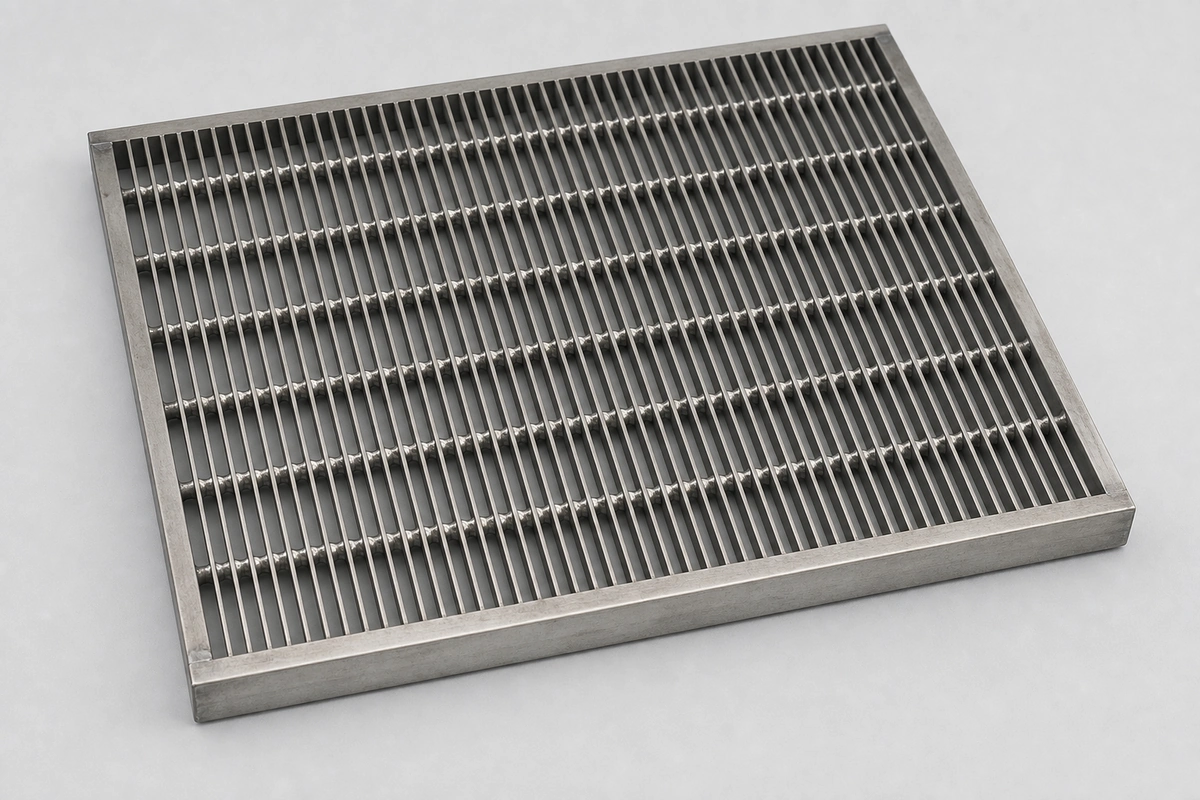
Wedge Wire Screen Panels woven or fabricated in Monel 400 (UNS N04400 (2.4360)) keeps its dimensional specification to Industry standard (V-wire); the alloy determines corrosion behavior (excellent resistance to seawater, hydrofluoric acid and alkalis) and the service temperature limit (approx. +540 °C). Both are covered below with the full specification table.

Why Choose Monel 400 for Wedge Wire Screen Panels

The marine and chemical-processing specialist alloy. For wedge wire screen panels, this matters when excellent resistance to seawater, hydrofluoric acid and alkalis is the controlling requirement.

Alloy Properties

Grade designationUNS N04400 (2.4360)
Magnetic responseSlightly magnetic
Service temperatureapprox. +540 °C
Corrosion characteristicExcellent resistance to seawater, hydrofluoric acid and alkalis

Corrosion Behavior in Filtration Service

Nickel-family alloys are specified for wedge wire screen panels when stainless is not enough: Monel 400 for seawater and hydrofluoric acid, Inconel 600 for oxidation at extreme temperature, Hastelloy C-276 for hot chlorides and mixed acids, titanium for chlorides with weight savings. Match the alloy to the specific chemistry — they are not interchangeable.

Comparable Alloys

Between the special alloys, selection is chemistry-led: Monel 400 (HF, seawater), Inconel 600 (heat/oxidation), Hastelloy C-276 (broadest acid resistance), nickel 200 (caustic), titanium (chlorides, weight). 316L remains the cost benchmark — specify a special alloy only when the datasheet chemistry demands it.

Specifications of Wedge Wire Screen Panels Available in Monel 400

Slot opening (mm)Wire profile (mm)Support rod (mm)Open area (%)Tolerance
0.05V-profile 1.5 x 2.5Rod 3 x 58Slot tolerance u00b10.02
0.10V-profile 1.5 x 2.5Rod 3 x 512Slot tolerance u00b10.02
0.25V-profile 2.2 x 3.0Rod 3 x 518Slot tolerance u00b10.03
0.50V-profile 2.2 x 3.0Rod 3 x 525Slot tolerance u00b10.05
1.00V-profile 3.0 x 5.0Rod 5 x 833Slot tolerance u00b10.05
3.00V-profile 3.0 x 5.0Rod 5 x 850Slot tolerance u00b10.10
6.00V-profile 3.3 x 6.0Rod 5 x 860Slot tolerance u00b10.10

Technical Drawing

Customize the parameters below — every spec field is editable, and the drawing redraws to match the values you choose. Changing the size will snap the other fields to that size's standard values; you can then override any individual value.

Sends the selected values to the quote form below.

Request a Quote

Adjust the parameters in the drawing above and click "Request this configuration" to send the exact specification straight to this form.

Request a Quotation

Specification
Business Information

Dimensions & Specifications (Industry standard (V-wire))

Slot opening (mm)Wire profile (mm)Support rod (mm)Open area (%)Tolerance
0.05V-profile 1.5 x 2.5Rod 3 x 58Slot tolerance u00b10.02
0.10V-profile 1.5 x 2.5Rod 3 x 512Slot tolerance u00b10.02
0.25V-profile 2.2 x 3.0Rod 3 x 518Slot tolerance u00b10.03
0.50V-profile 2.2 x 3.0Rod 3 x 525Slot tolerance u00b10.05
1.00V-profile 3.0 x 5.0Rod 5 x 833Slot tolerance u00b10.05
3.00V-profile 3.0 x 5.0Rod 5 x 850Slot tolerance u00b10.10
6.00V-profile 3.3 x 6.0Rod 5 x 860Slot tolerance u00b10.10

Frequently Asked Questions

What corrosion resistance does Monel 400 offer?

Monel 400 provides excellent resistance to seawater, hydrofluoric acid and alkalis, with a practical service range of approx. +540 °C.

What temperature can Monel 400 wedge wire screen panels run at?

The practical continuous service limit is approx. +540 °C. Above it, oxidation scales the wire surface and the aperture drifts; for hotter duty move up the alloy ladder (Inconel, and sintered constructions for mechanical stability).

When is Monel 400 worth the premium over stainless?

Specify Monel 400 when the datasheet chemistry rules stainless out — excellent resistance to seawater, hydrofluoric acid and alkalis. For everything else, 316L is usually the economic choice.

Can Monel 400 wedge wire screen panels be welded into frames?

Yes — spot, TIG and plasma welding are standard for framing and edging. Use matching filler, keep heat input low to protect the fine wires, and re-passivate stainless after fabrication.

How do I request a quotation?

Use the technical drawing on this page to pick the exact specification, then submit it with the quote form. We respond within one business day.