Skip to content

Expanded Metal · DIN 791 / ASTM F1267 · Application guide

What Is Standard (Raised) Expanded Metal Used For?

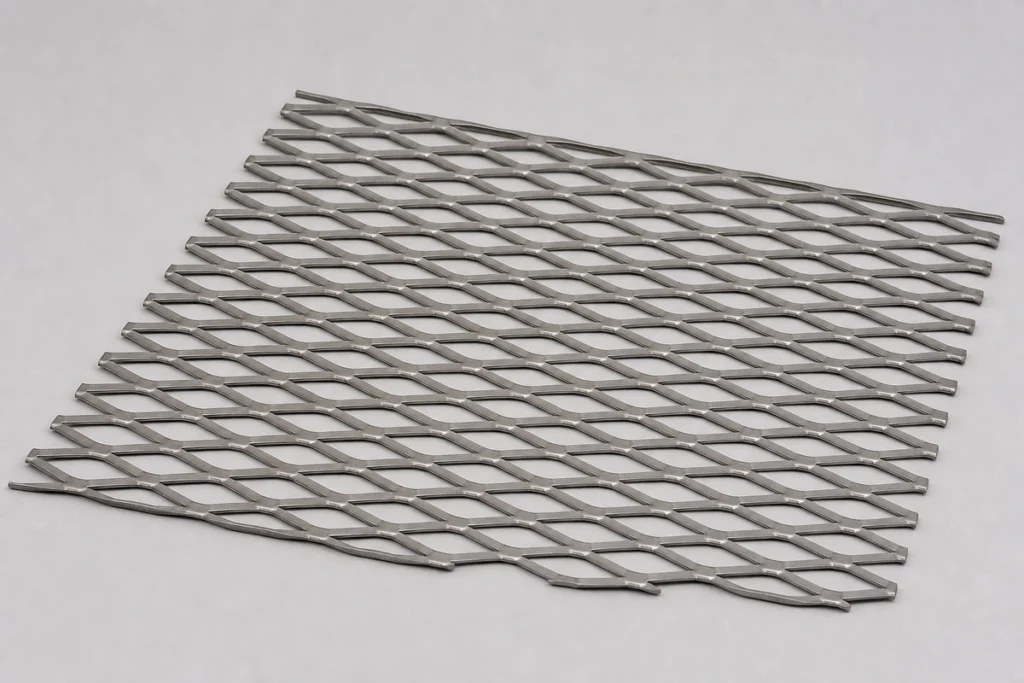
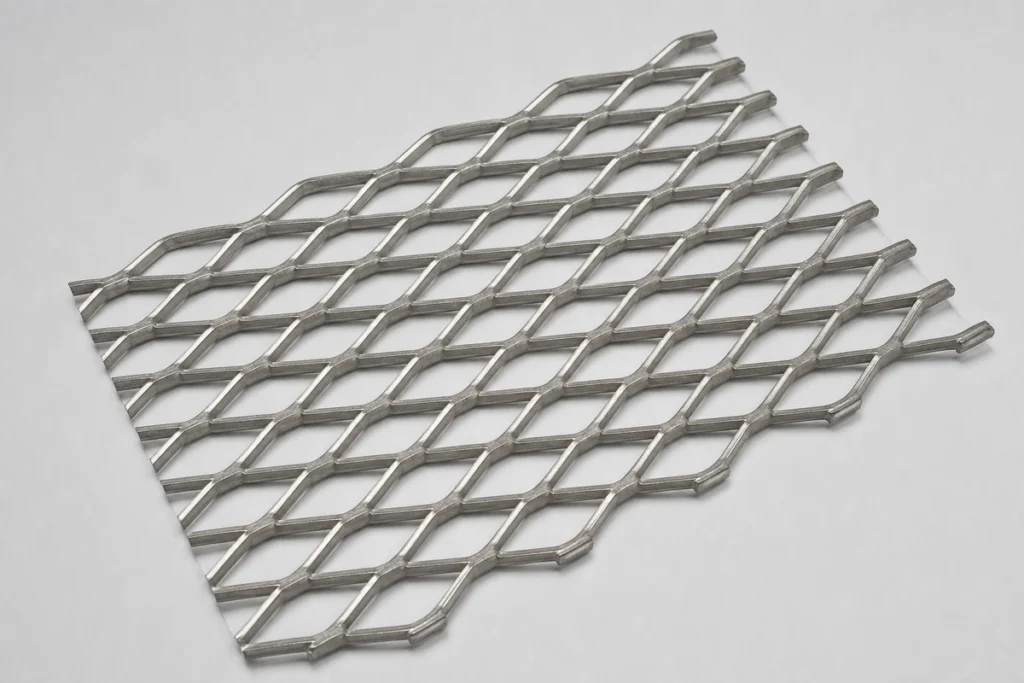
The primary duty of Standard (Raised) Expanded Metal is walkways, guards, screens and facades that need a strong, one-piece slit-and-stretched mesh. Below: the sectors that specify it in volume, the checklist used to select the right mesh and alloy for the application, handling notes, and the known limits of the type.

Typical Applications for Standard (Raised) Expanded Metal

The most common settings where this is specified:

  • Security & infill: fencing, grilles and partition infill.
  • Architecture: facades and decorative screens.
  • Machine guards: strong, ventilated one-piece guarding.
  • Industrial filtration & separation: removing particulates from liquids, gases and slurries in process plant.
  • OEM & fabrication: cut, formed and welded into filter assemblies, screens, guards and enclosures.

How to Specify Standard (Raised) Expanded Metal for Your Application

  • Mesh count / micron rating: Match the aperture or micron rating to the smallest particle you must retain or pass. The table below lists mesh count, aperture and micron for each option — for woven cloth, specify the aperture or micron, not just the mesh count.
  • Pattern & thickness: Choose standard (raised) for grip or flattened for a smooth face, and the strand and sheet thickness for the load and span.
  • Material / alloy: Select the alloy for the environment — 304 for general use, 316L for chlorides, food and chemicals, brass or copper for shielding, and Monel, Inconel or Hastelloy for marine, acid and high-temperature service.
  • Environment: For damp, coastal, chemical or high-temperature service move up to 316L or a nickel alloy; for dry indoor duty 304 or a coated steel is usually enough.
  • Standard: This product is supplied to DIN 791 / ASTM F1267. Quoting the standard on your order guarantees interchangeable dimensions and filtration data between suppliers.

Handling & Installation Practice

  • Orient the long way of the diamond (LWD) across the span for maximum stiffness, and support the short-way edges.
  • Band or frame the cut edges — the strands are sharp — and fix through the bond points, not the strands.

Common Selection Mistakes with Standard (Raised) Expanded Metal

  • Confusing standard (raised) with flattened expanded metal — raised has a three-dimensional grip texture, flattened is smooth and lower.
  • Loading the short way of the diamond, where the mesh is weakest, instead of the long way.

Where Standard (Raised) Expanded Metal Is Not the Right Choice

Not for precise particle separation (the aperture is not a controlled filtration opening) and not where a perfectly flat, smooth surface is required.

Technical Drawing

Customize the parameters below — every spec field is editable, and the drawing redraws to match the values you choose. Changing the size will snap the other fields to that size's standard values; you can then override any individual value.

Sends the selected values to the quote form below.

Request a Quote

Set the size and options in the drawing above, then send the exact configuration straight to this form.

Request a Quotation

Specification
Business Information

Dimensions & Specifications (DIN 791 / ASTM F1267)

Mesh designation (SWD x LWD)SWD (mm)LWD (mm)Strand width (mm)Strand thickness (mm)Open area (%)
6x126121.01.062
10x2010201.51.566
12.5x2512.5252.02.060
16x3416342.02.070
22x5022503.03.067
30x6030603.53.072
50x100501005.04.075

Frequently Asked Questions

What material should Standard (Raised) Expanded Metal be for corrosive or outdoor service?

For damp, coastal, chemical or food duty specify 316L stainless (or a nickel alloy such as Monel or Inconel for severe service). For dry indoor use, 304 stainless or a coated steel is normally adequate.

Is Standard (Raised) Expanded Metal made to a recognized standard?

Yes — it is manufactured to DIN 791 / ASTM F1267, so dimensions and filtration data are interchangeable between suppliers when you quote the standard on your order.

What is Standard (Raised) Expanded Metal used for?

Walkways, guards, screens and facades that need a strong, one-piece slit-and-stretched mesh. It is supplied to DIN 791 / ASTM F1267.

Which industries use Standard (Raised) Expanded Metal?

It is commonly specified in industrial filtration & separation, oem & fabrication and maintenance & replacement (mro), among other sectors.

Can I get a quote for Standard (Raised) Expanded Metal in the mesh and material I need?

Yes. Use the technical drawing and quote form on this page to set the mesh, micron and alloy, then send the exact configuration to our team for pricing and lead time.