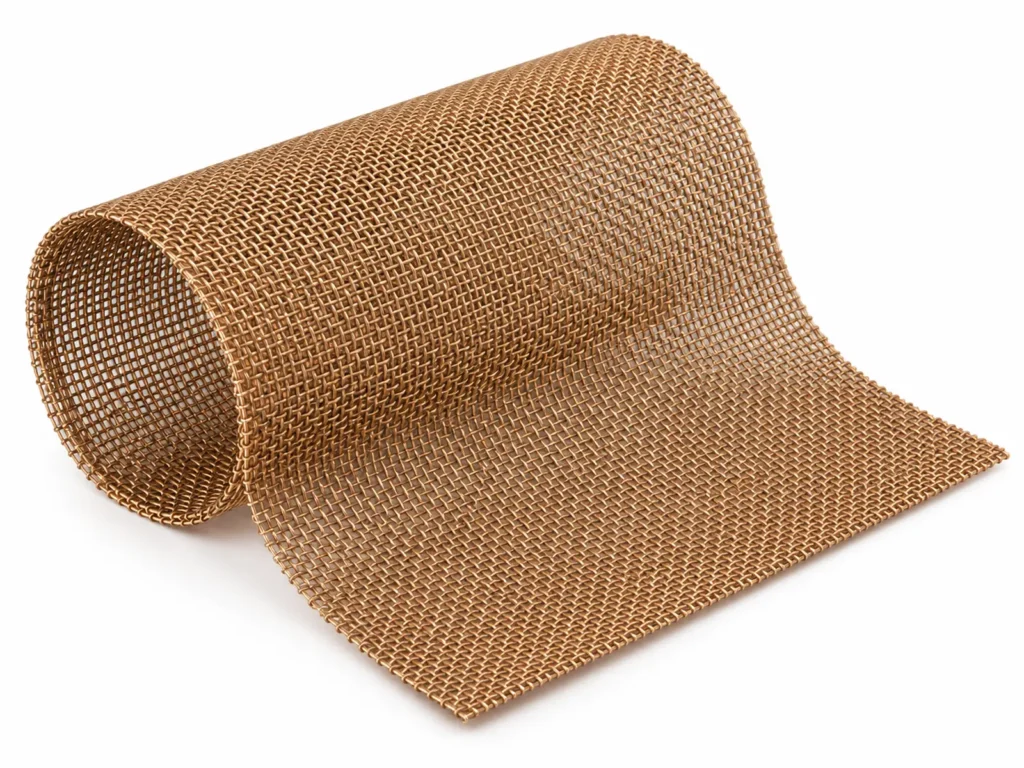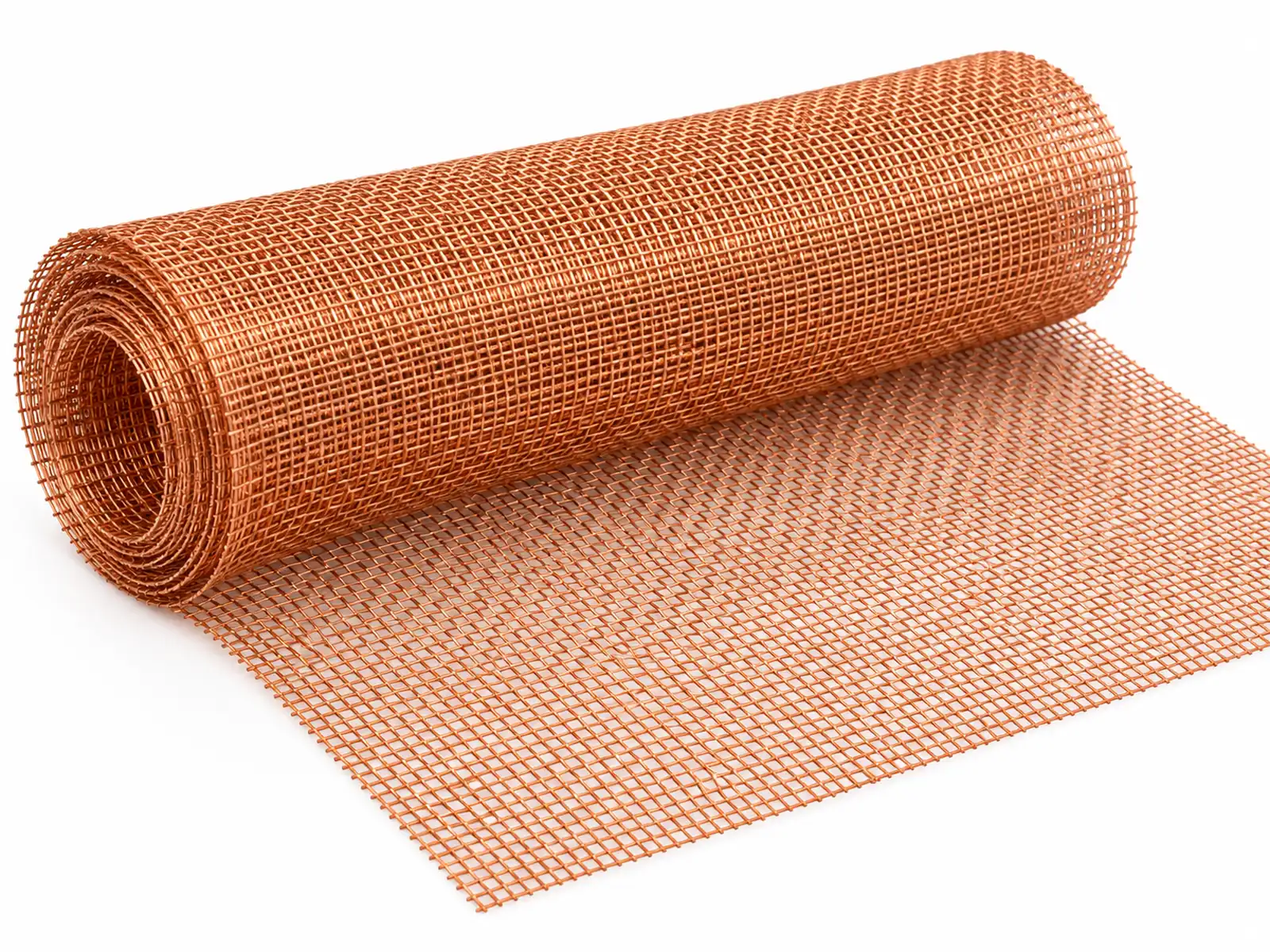
Copper Wire Mesh is used for conducting, shielding and screening with woven pure copper cloth — the go-to metal mesh for RF shielding, grounding grids, battery and electrochemical work and copper-specific screening. ISO 9044 is the reference cited for it on drawings, datasheets and purchase orders.
What ISO 9044 Means for Copper Wire Mesh
The dimensions in the table below are supplied to suit ISO 9044. Where the standard sets requirements for the finished appliance, device or system, compliance testing of that assembly stays with its manufacturer; we supply the metal mesh part to the drawing and can provide material certificates and dimensional reports with the shipment.
Equivalent Standards
ISO 9044 (industrial woven wire cloth) corresponds closely to ASTM E2016; both use the ISO 565 / ASTM E11 aperture series as their dimensional backbone.
Copper Wire Mesh Dimensions
| Mesh count | Wire diameter (mm) | Aperture (mm) | Micron rating (u00b5m) | Open area (%) | Alloy |
|---|---|---|---|---|---|
| 16-Mesh | 0.280 | 1.308 | 1308 | 67.6 | C11000 ETP copper |
| 22-Mesh | 0.115 | 1.040 | 1040 | 81.0 | C11000 ETP copper |
| 40-Mesh | 0.250 | 0.385 | 385 | 36.8 | C11000 ETP copper |
| 60-Mesh | 0.110 | 0.313 | 313 | 55.0 | C11000 ETP copper |
| 100-Mesh | 0.110 | 0.144 | 144 | 32.0 | C11000 ETP copper |
| 150-Mesh | 0.066 | 0.103 | 103 | 37.2 | C11000 ETP copper |
Specifying Copper Wire Mesh Beyond the Standard
- Mesh & wire: Finer mesh with heavier wire improves high-frequency shielding; coarser, thinner wire keeps it flexible and light.
- Purity: C11000 ETP (99.9 % Cu) for conductivity; specify C10200 oxygen-free where it will be brazed or used in hydrogen.
- Temper & finish: Soft annealed for forming around frames; bright or tinned to slow tarnish on contact faces.
When Copper Wire Mesh Is Not the Right Choice
Not a structural mesh and not suitable for drinking water, ammonia or acidic process streams — choose stainless steel there.