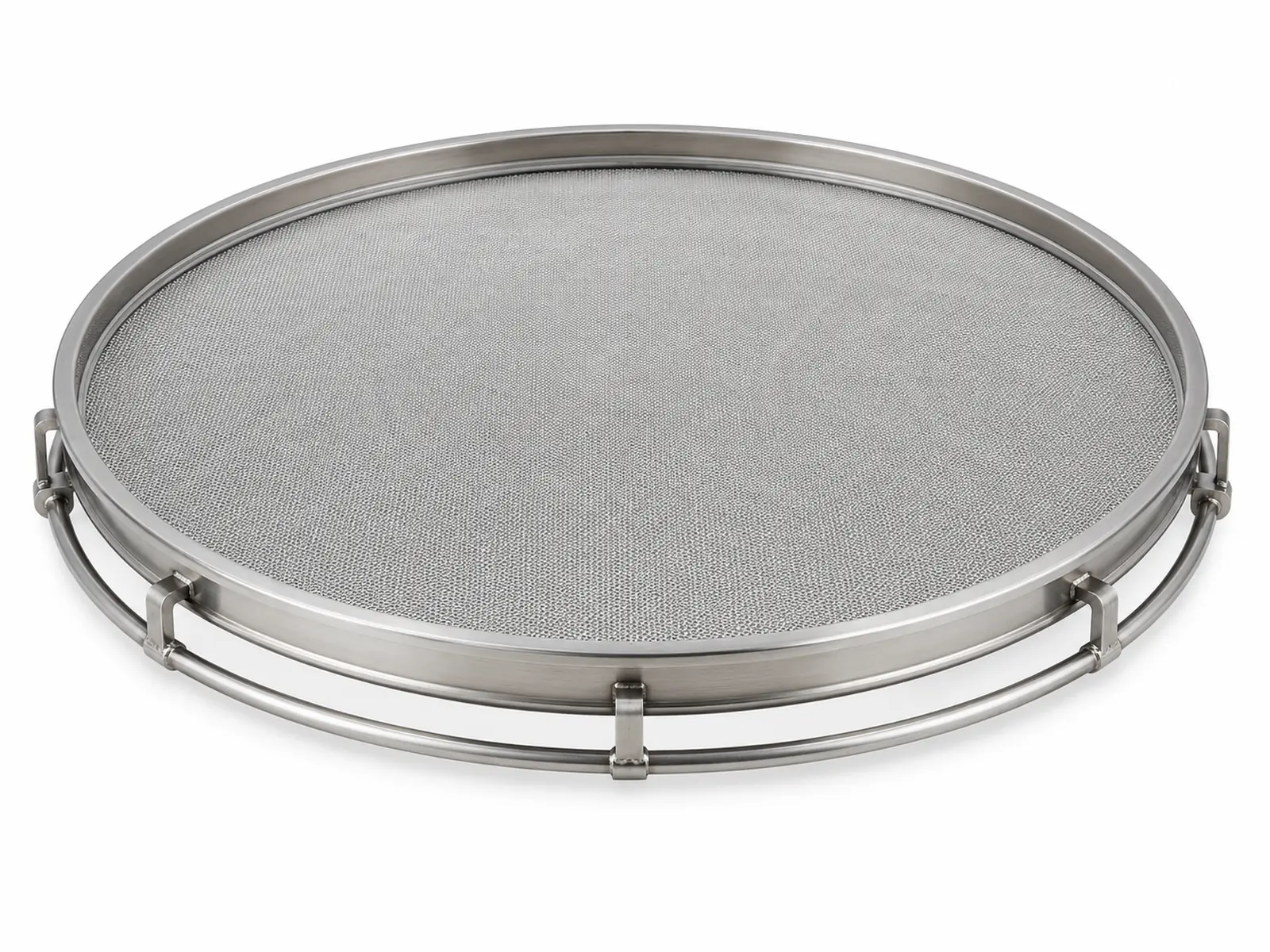
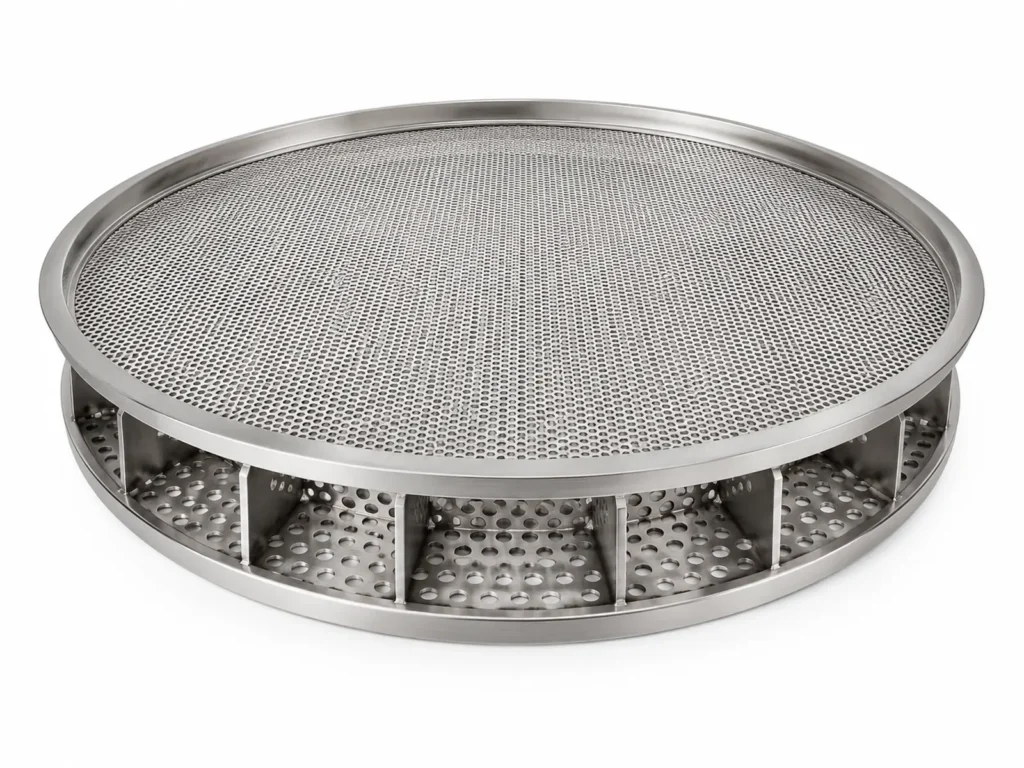
Ultrasonic Vibrating Sieve Screen in 316L Stainless Steel (AISI 316L (1.4404)) is used for sieving fine and electrostatic powders on vibratory sifters with a stainless mesh screen driven by an ultrasonic transducer ring that stops blinding. The alloy gives superior resistance, including chlorides, brines, food CIP and mild acids and is essentially non-magnetic, with a practical service limit of approx. +550 °C continuous.
Alloy Properties
| Grade designation | AISI 316L (1.4404) |
|---|
| Magnetic response | Essentially non-magnetic |
|---|
| Service temperature | approx. +550 °C continuous |
|---|
| Corrosion characteristic | Superior resistance, including chlorides, brines, food CIP and mild acids |
|---|
Specifications of Ultrasonic Vibrating Sieve Screen Available in 316L Stainless Steel
| Size | Frame diameter (mm) | Frame height (mm) | Mesh count | Aperture (mm) | Transducer |
|---|
| 600 / 200-mesh | 600 | 60 | 200-Mesh | 0.074 | 36 kHz ring |
| 800 / 325-mesh | 800 | 60 | 325-Mesh | 0.042 | 36 kHz ring |
| 1000 / 400-mesh | 1000 | 80 | 400-Mesh | 0.034 | 2 u00d7 36 kHz |
| 1500 / 500-mesh | 1500 | 80 | 500-Mesh | 0.026 | 3 u00d7 36 kHz |
Where 316L Stainless Steel Ultrasonic Vibrating Sieve Screen Is Used
- Metal powders & additive manufacturing: sieving titanium, nickel and stainless powders at 15–60 µm.
- Battery materials: cathode and anode powder screening.
- Pharmaceutical & nutraceutical: fine API and excipient sieving.
- Pigments & toners: fine powder classification.
Ordering Ultrasonic Vibrating Sieve Screen in 316L Stainless Steel
- Frame size: Match the sifter diameter (600–1500 mm).
- Mesh: 200–500 mesh; ultrasonic drive becomes essential below about 100 µm.
- Transducer & cable: Ring transducer frequency and generator compatibility.
Mistakes to Avoid with Ultrasonic Vibrating Sieve Screen
- Running ultrasonics on slack cloth, which tears it.
- Mixing generator and transducer from different makers.