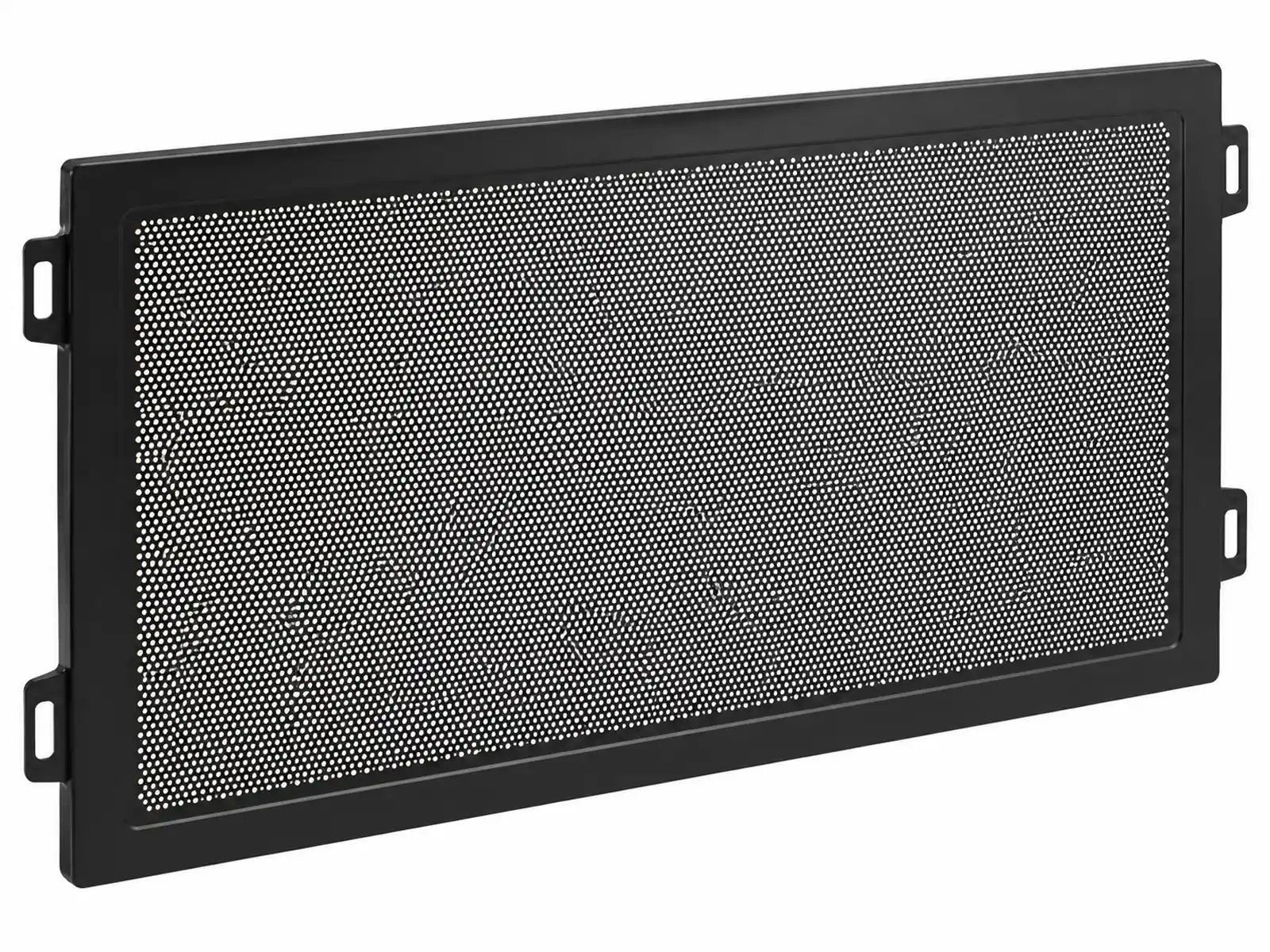
Microwave Oven Door Shield Screen in 304 Stainless Steel (AISI 304 (1.4301)) is used for blocking microwave energy at the oven door while users can still see the food, using a perforated metal screen whose 1–2 mm holes are far smaller than the 12 cm wavelength. The alloy gives good general corrosion resistance in atmosphere and fresh water and is essentially non-magnetic (annealed), with a practical service limit of approx. +450 °C continuous.
Alloy Properties
| Grade designation | AISI 304 (1.4301) |
|---|
| Magnetic response | Essentially non-magnetic (annealed) |
|---|
| Service temperature | approx. +450 °C continuous |
|---|
| Corrosion characteristic | Good general corrosion resistance in atmosphere and fresh water |
|---|
Specifications of Microwave Oven Door Shield Screen Available in 304 Stainless Steel
| Size | Hole diameter (mm) | Pitch (mm) | Thickness (mm) | Open area (%) | Material |
|---|
| 20 L door | 1.5 | 2.2 | 0.4 | 42.2 | Cold-rolled steel, black |
| 25 L door | 1.5 | 2.2 | 0.4 | 42.2 | Cold-rolled steel, black |
| 32 L door | 1.6 | 2.4 | 0.5 | 40.3 | SS430 |
| Built-in combi | 1.2 | 2.0 | 0.5 | 32.6 | SS304 |
Where 304 Stainless Steel Microwave Oven Door Shield Screen Is Used
- Microwave oven OEMs: door shield screens in countertop and over-the-range ovens.
- Combi & speed ovens: door shields in commercial microwave-convection ovens.
- Appliance service centers: replacement door assemblies after impact damage.
- Laboratory microwave systems: viewing-window shields in digestion and synthesis units.
Ordering Microwave Oven Door Shield Screen in 304 Stainless Steel
- Hole diameter & pitch: 1.2–1.6 mm holes keep leakage well under the 5 mW/cm² limit when the door is correctly sealed.
- Open area: Higher open area improves visibility; balance it against shielding margin.
- Material & finish: Black-coated cold-rolled steel for contrast; SS430 for premium doors.
Mistakes to Avoid with Microwave Oven Door Shield Screen
- Enlarging holes for visibility, which reduces shielding.
- Fitting an uncertified mesh in a repair, which can fail leakage tests.